This year I spent nearly a month aboard Queen Mary 2, most of which was at sea. Consequently the ship became as important as the destination, and towards the end of my third journey I was lucky enough to get a place on a behind the scenes tour. You weren’t allowed to take any photographs during the 3 hour tour and it wasn’t cheap, but it was an amazing experience.

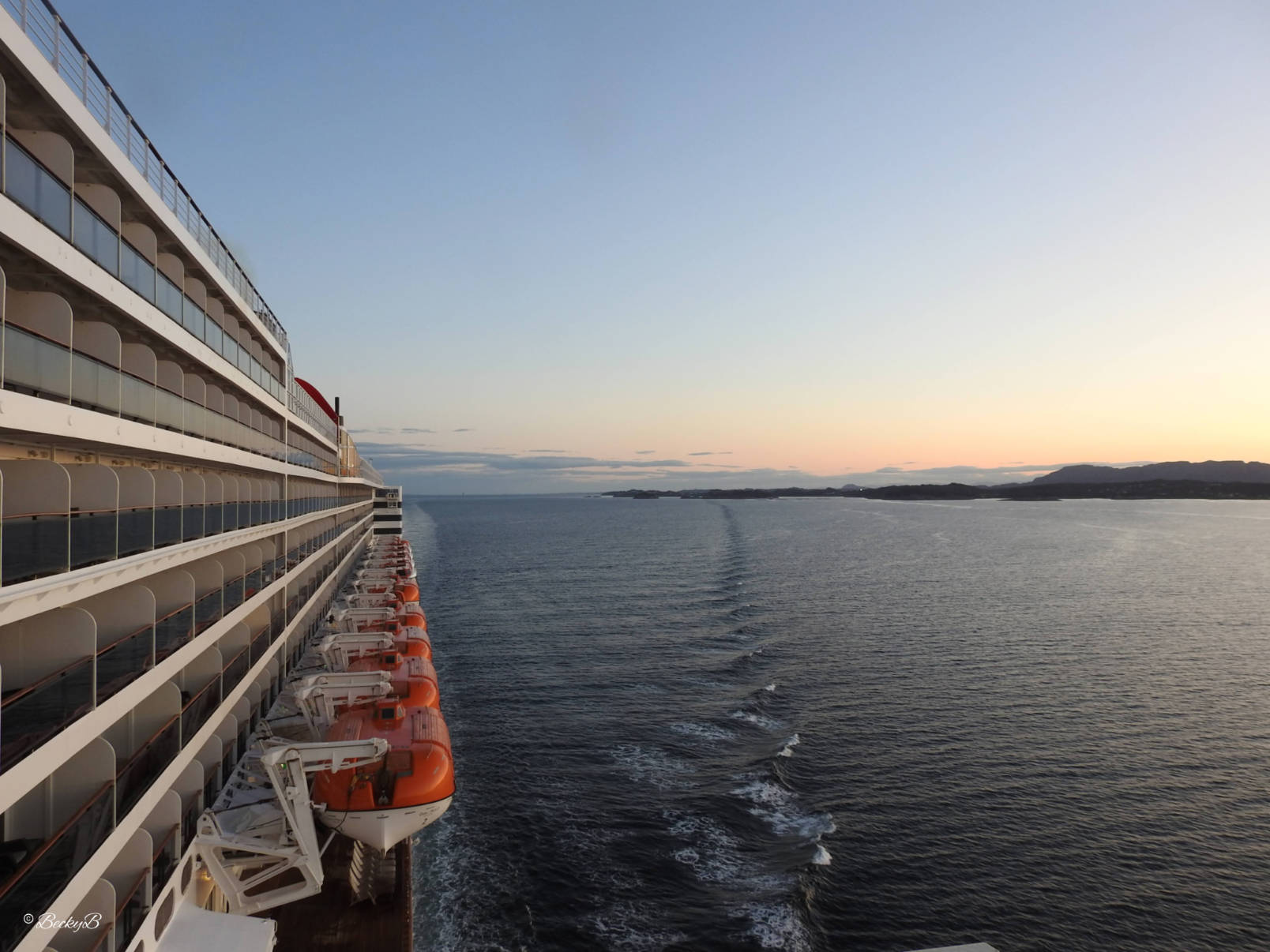
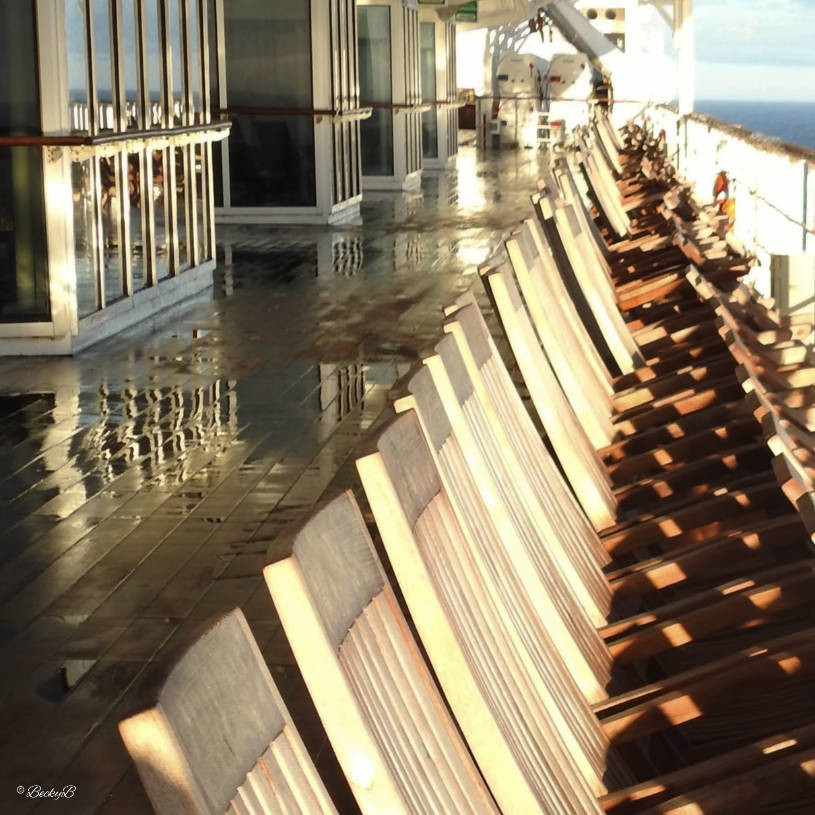
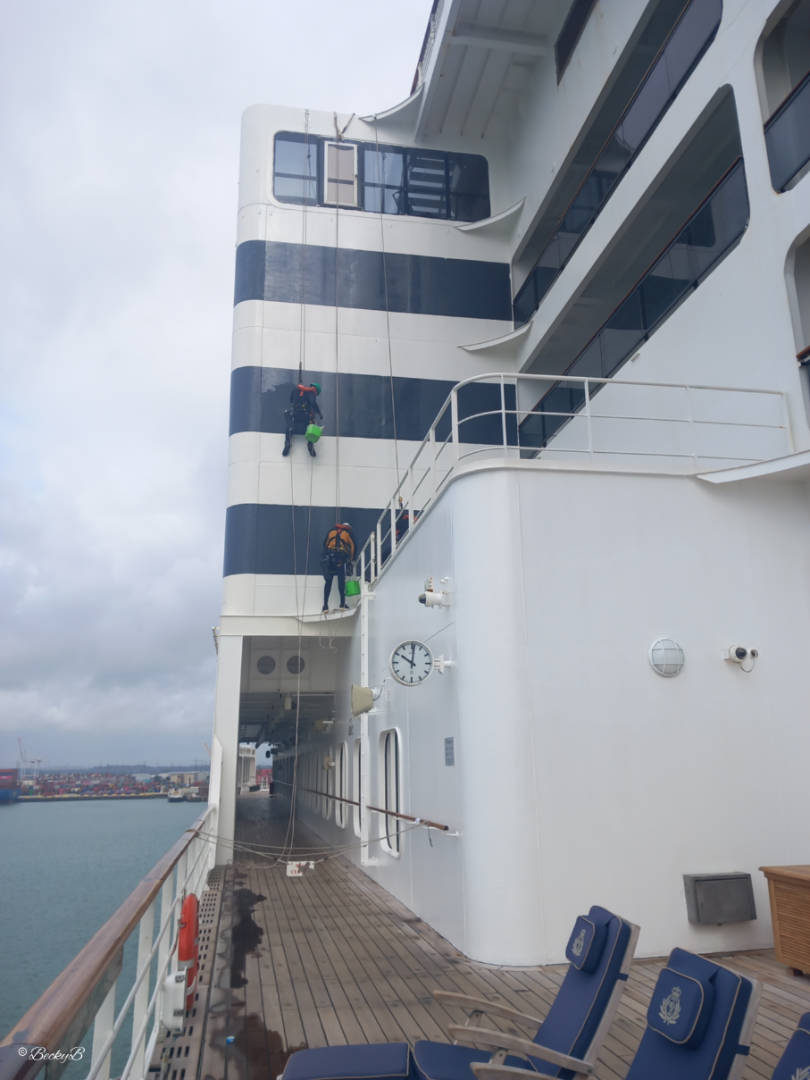
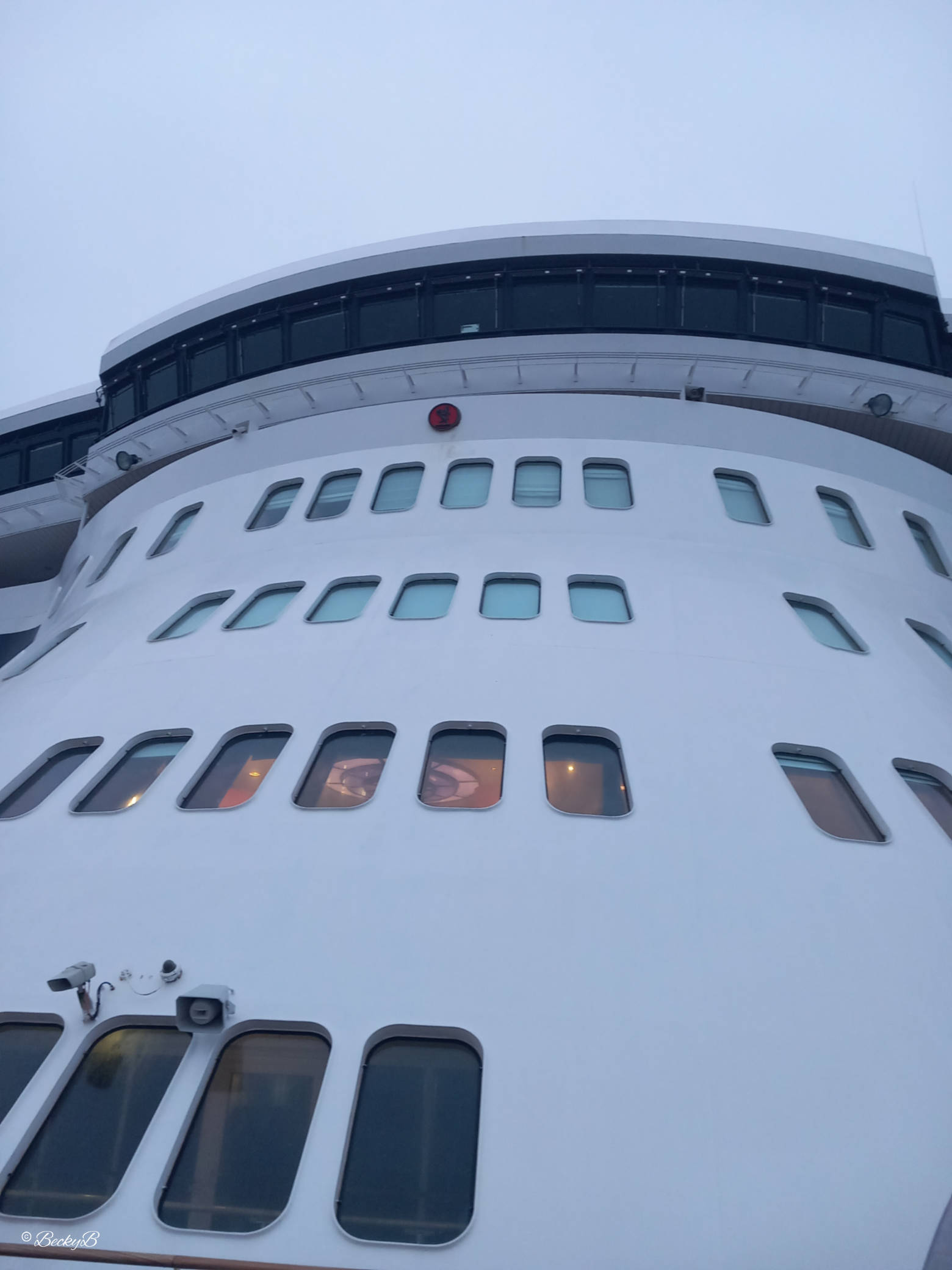
Today I thought I’d share a few facts and figures from the tour as well as few more angles of the ship. I am rather proud of myself of how the gallery above has worked; showing decks 7 thru 14 with starboard in the Atlantic and port in a Norwegian fjord.
You might get a better sense of the scale though if you travel from deck seven in one of the lifts with me.
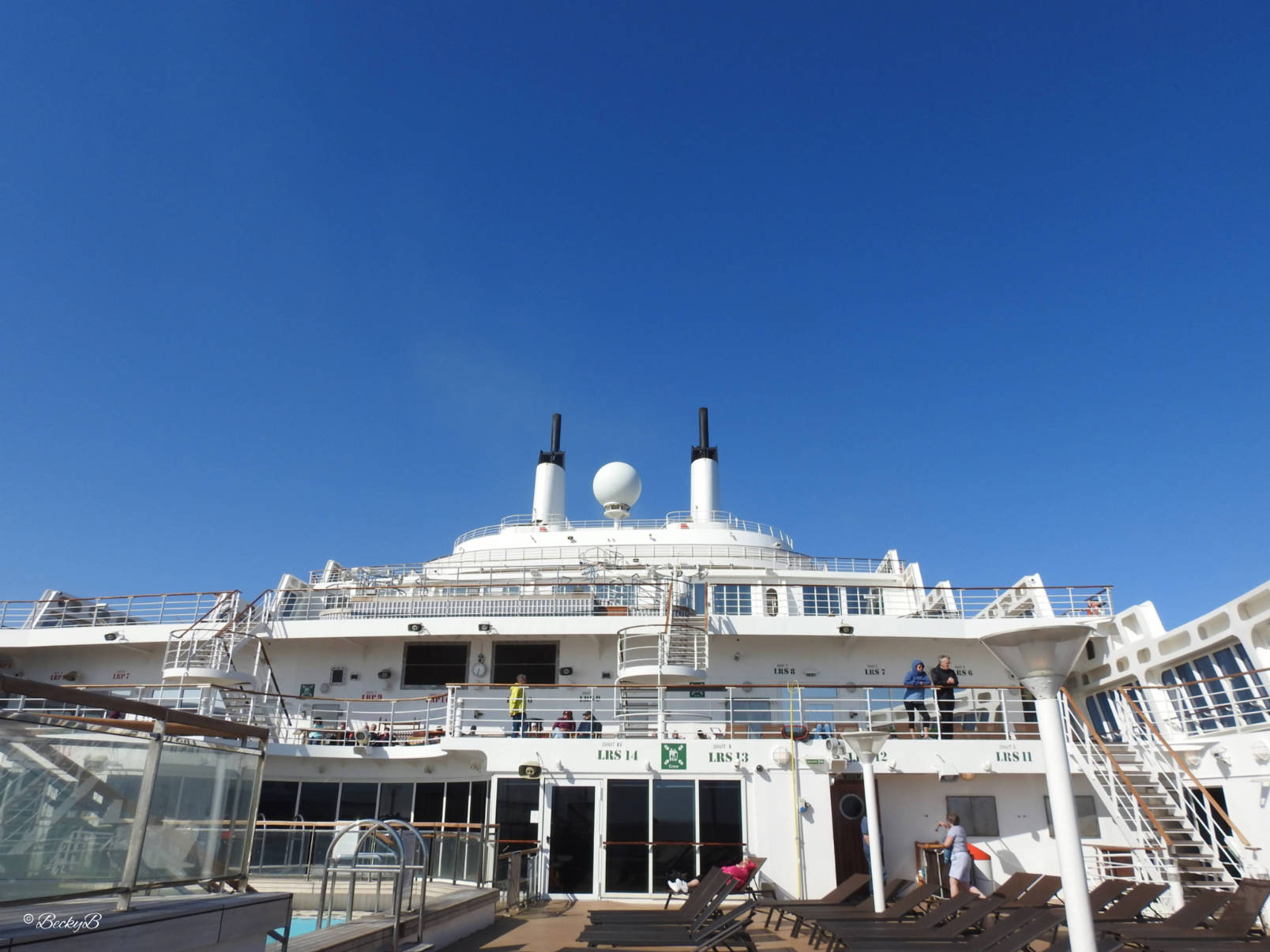
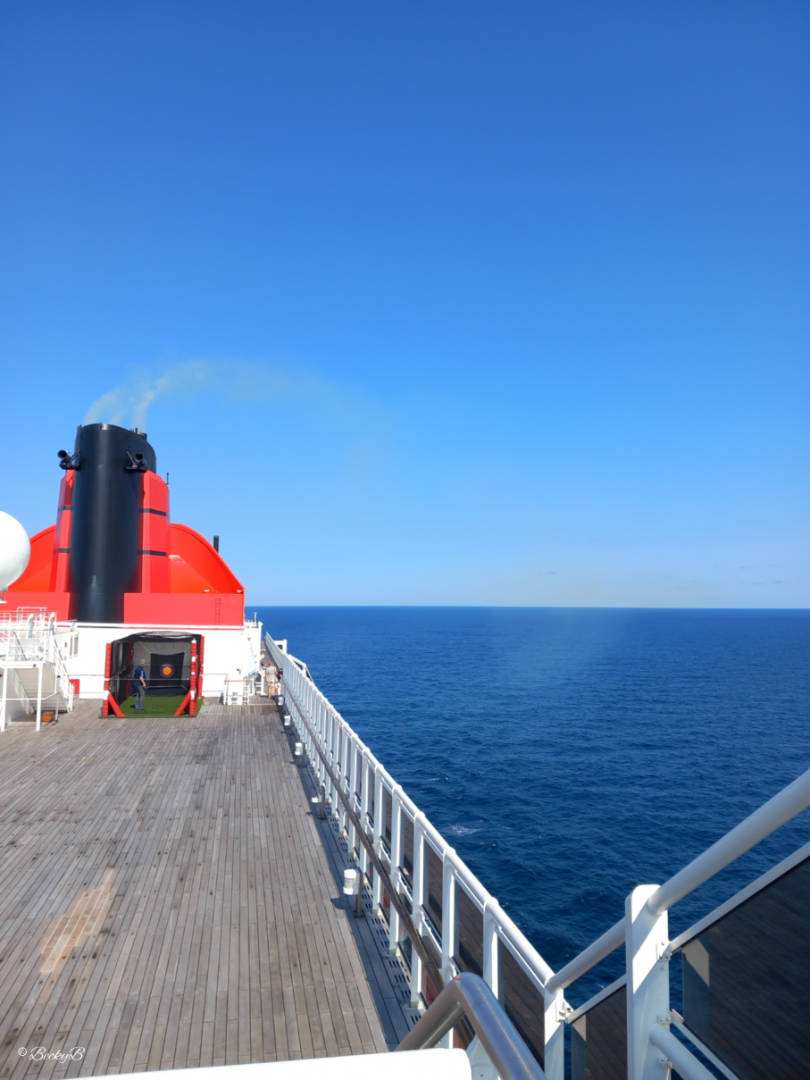
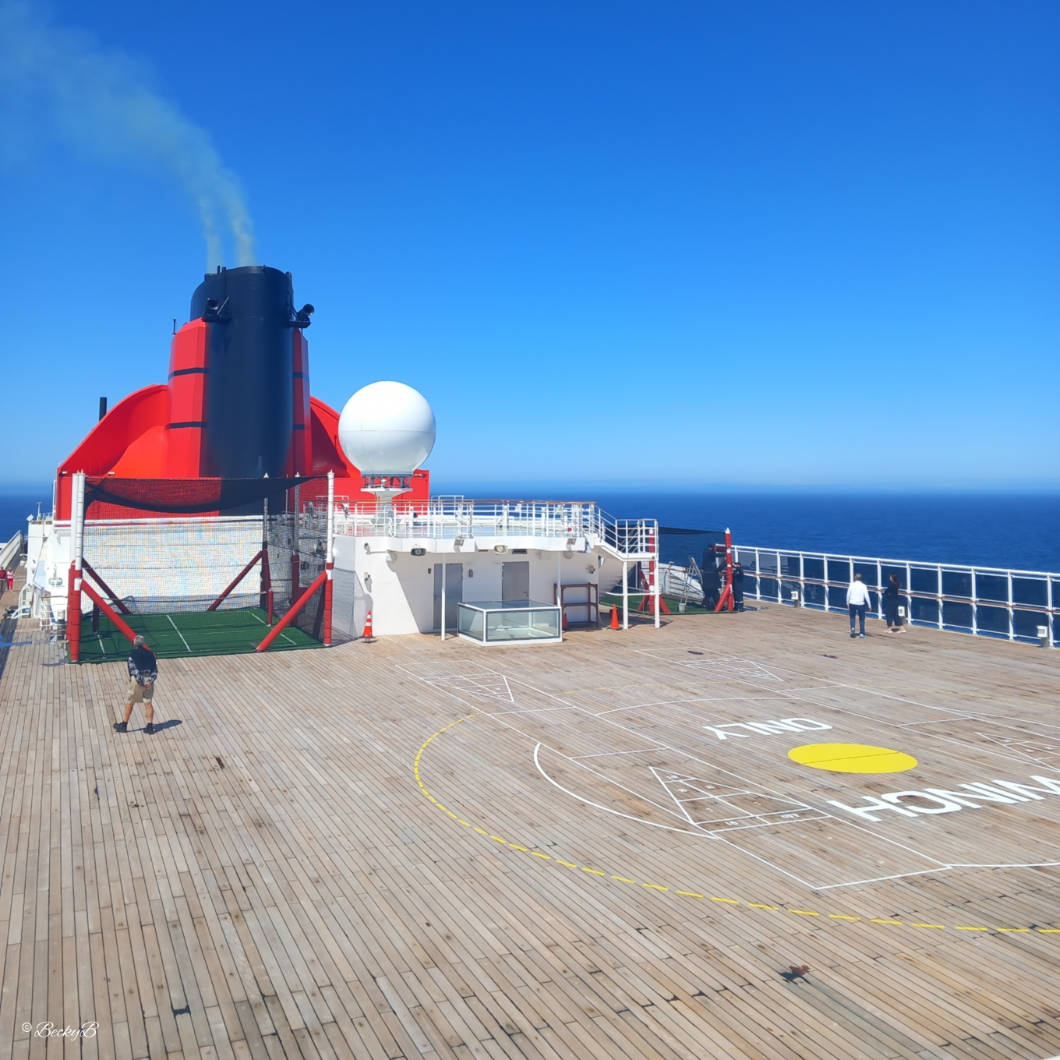
QM2 is 1132 ft (345m) long and 145ft (45m) wide, and has 13 passenger decks and another 3 for crew. Her funnel is 204ft above the waterline and her draft is over 33ft; equivalent to a 23 storey building! Therefore I guess it is not surprising that her Engine Control Room is manned 24hours, with the watch keepers working a rotation of 4 hours on, 8 hours off.
I was surprised though about water production. Hadn’t really occurred to me before I went on the tour, but if you had asked I probably would have said there must be huge water tanks somewhere, Well there are, but the tanks can only hold 1,011,779 US gallons and the daily consumption of water (including that needed for cooking the 16,000 meals per day and washing the ship) is at least a quarter of that. So Queen Mary has to produce her own potable water; around 630 tonnes of water a day! She also has her own waste water / sewage treatment system, and a separate system for all the waste food. She even produces steam for the heating, laundry and galleys.
Goes a long way to explain why there are so many officers, ratings and other crew; circa 1100 people. Most of whom are on board for 6 to 9 months at a time.


She has gas and diesel engines, which gives Queen Mary much more flexibility. She doesn’t have conventional rudders but instead what are called pods. There are four in total; two fixed to give forward and aft thrust, and two manoeuvrable ones which can provide side thrust. As a car carries a spare wheel, Queen Mary carries spare propellers for the pods and also a spare anchor. The spares are not hidden away but can be seen on the bow, and are often mistaken for modern works of art.


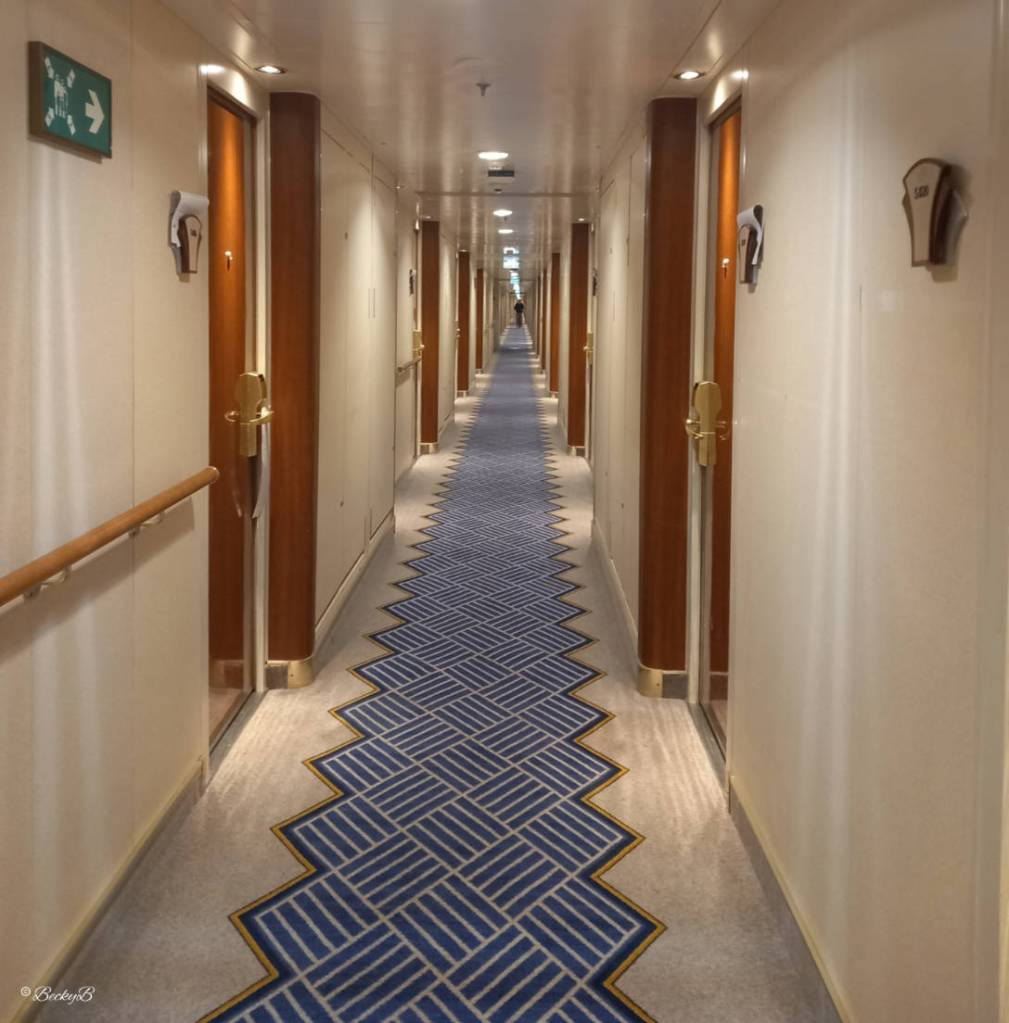
There is a central corridor, called the Burma Road, which runs from the bow to the stern. Its name a leftover from when the original Queen Mary was used by the British as a transport ship in WW2. Another leftover is the fact Cunard officers wear their rank insignia on their sleeves (rather than the usual cruise epaulettes) in recognition of Cunard’s efforts during WW2. The ships were used as troop transport, U-boats couldn’t keep up with them so usually they weren’t escorted. One crossing more than 16,000 troops were carried on board on Queen Mary. Royal Navy officers didn’t operate Cunard ships in wartime, the Cunard officers did and if the ships were ever requisitioned again they would do so again.

Our tour didn’t just cover what happens in the engine room, the anchor room, the bridge, back stage or the staff quarters. We also got to visit the store rooms, walk inside one of the 21 fridges and freezers and go into the galley. We learnt her whistles are audible 10 miles away and we had a chat with the kennel master; yup there is a dedicated kennels for cats and dogs on the transatlantic crossings.
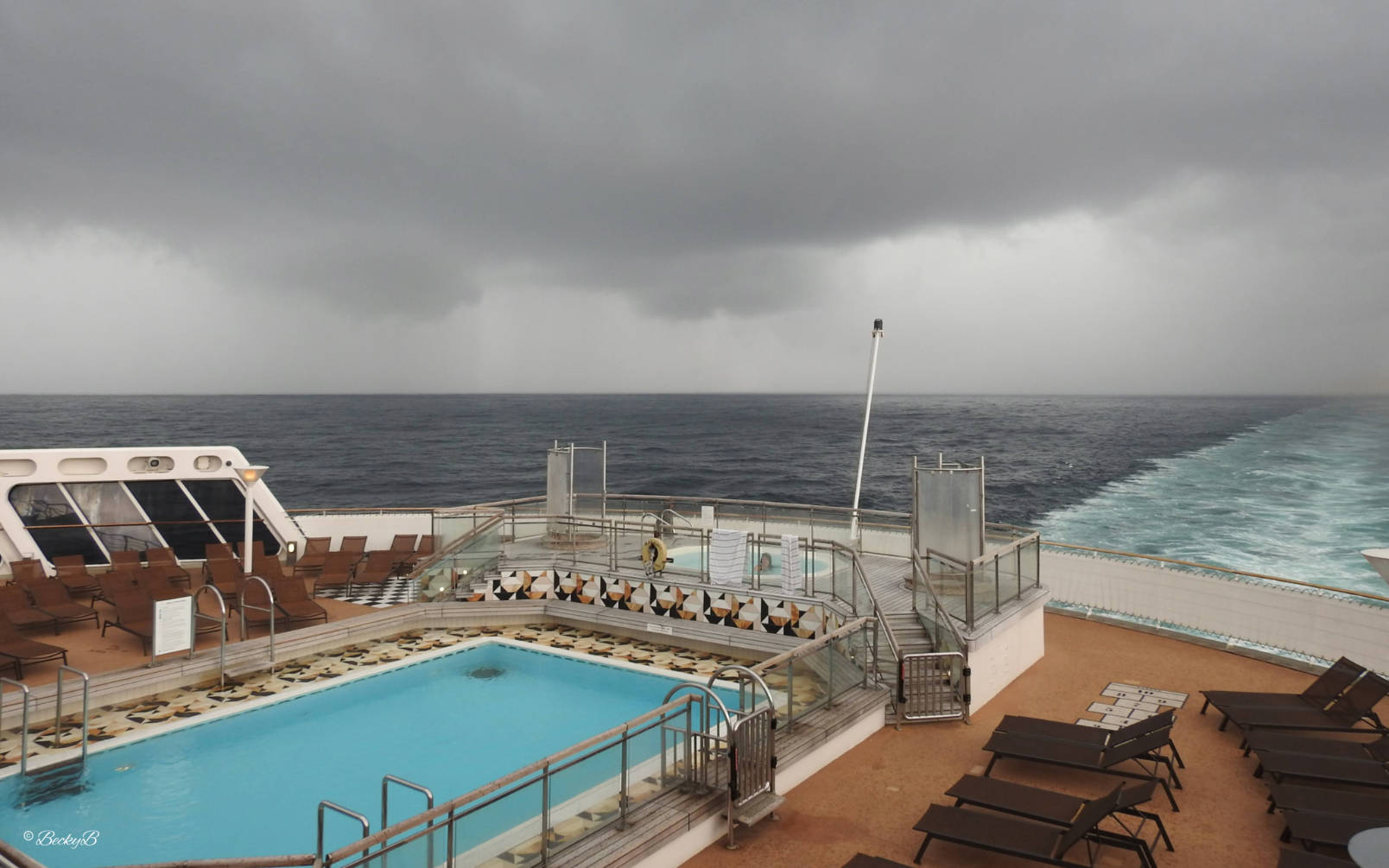
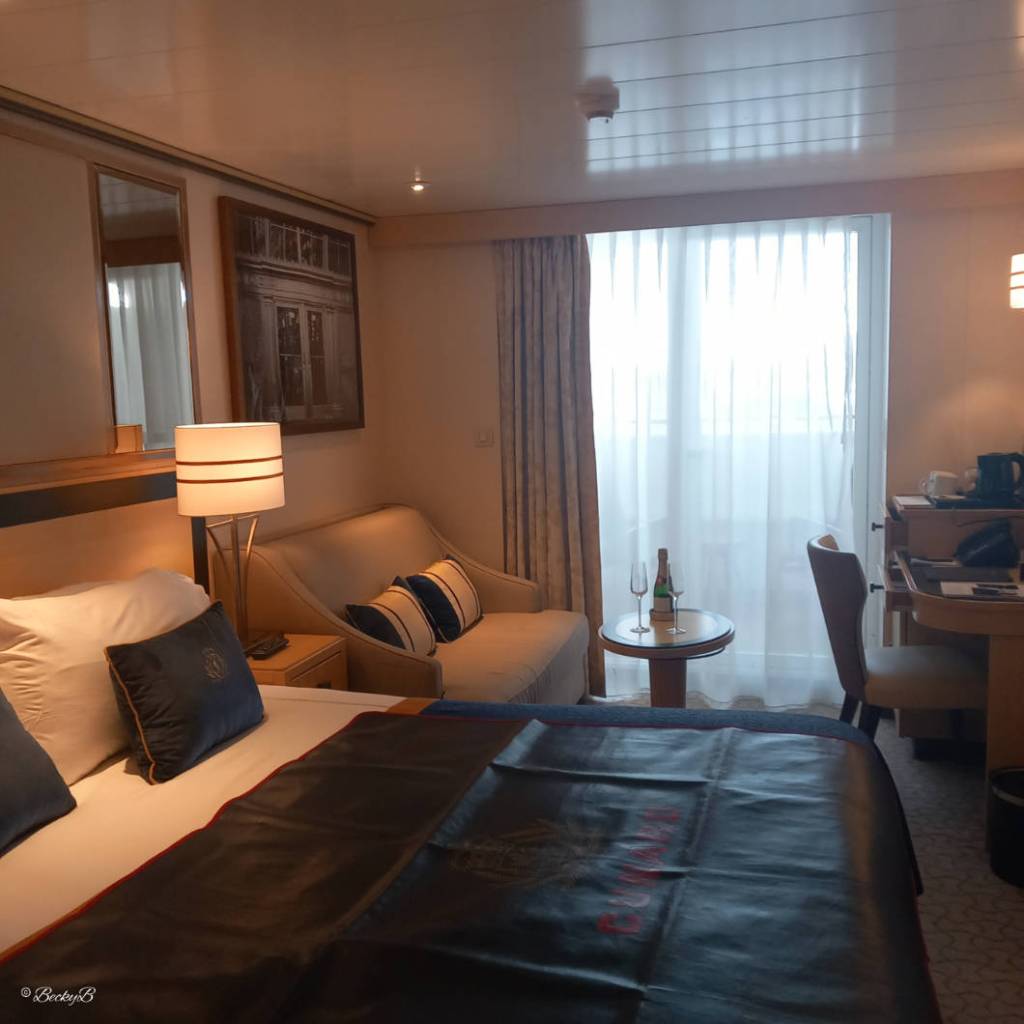
Her stablisers stop it from rolling even with 21ft waves, however as I also discovered first hand they can’t stop the pitching. One day when the waves were around 11ft I could see the stern well below me as I walked from the bow to stern. Later on I even found myself walking on air! Fortunately I was asleep when the waves reached 21ft so didn’t see what was happening outside then. But let’s now take you inside with a few shots in the passenger areas.



Everything is on a large scale in the kitchen; there is an escalator between the galley and upper floor of the restaurant, and I think I could have stood inside one of the soup kettles. We learnt that on a typical seven day transatlantic crossing the following quantities of food are consumed;
- 50 tons of Fresh Fruit & Vegetables
- 8 tons of meat, 2 tons of poultry and 13 tons of seafood
- 32,400 eggs, 4 tons of flour, 2 tons of sugar and 2 tons of rice
- 700 delicious English scones are served daily along with 6000 cups of tea
All of the above is served on approximately 87,000 pieces of china and glassware daily, and over 8000 linen napkins are used and laundered daily. The main restaurant serves up to 1,200 meals per seating and there are 5 other restaurants as well bars, room service and 3 dining areas for all the crew.
The logistics are almost mind blowing, especially when you discover that most of it is taken on board when they are in Southampton. So whilst your mind is reeling and thinking of multiple follow up questions to ask, here’s a 30 second video of us sailing the high seas.
It is very calming.
 The life of B
I thoroughly enjoyed this tour! What an amazing ship in size, scope, and history. I look forward to catching up on your other posts about your journey. I hope I can do something like this one day!
LikeLiked by 1 person
Awww thanks, so glad you enjoyed it 😊
LikeLiked by 1 person
Wow, that seems like a long time. But you seemed to enjoy every bit of it. Such lovely memories to cherish.
LikeLiked by 1 person
it was a long time, and certainly disrupted my year but incredible experience and very grateful to my cousin who made it happen
LikeLike
Looks amazing!
LikeLiked by 1 person
I don’t cruise but I love the history of the QM2. Great tour.
LikeLiked by 2 people
I never planned on going on a cruise, and felt very guilty doing it but it was an amazing experience.
LikeLiked by 1 person
Glad to here that it exceeded expectations. You went to some amazing places.
LikeLiked by 1 person
Quite amazing! What suddenly gave you the sailing bug?
LikeLiked by 1 person
Having a cousin to pay for it!!!
LikeLike
Handy!
LikeLiked by 1 person
Definitely a city on water!
Thank you so much for taking me along 🙂
LikeLiked by 1 person
so glad you enjoyed exploring with me
LikeLike
The mind boggles with those statistics, but like Margaret, I’m not a fan of cruise liners especially these mammoth ones.
LikeLiked by 1 person
I see my comment got lost in the ether. What I was adding was that I was pleased you were enjoying life on board (as well as on shore visits). I have to admit that I was one of those folk who was dead against cruising. But pressure wore me down and went on our first cruise some years ago, and from then hooked. Get on board and its instant relaxation, good food, comfort everywhere, different ports of call and folk to talk to. We made friend and kept in touch and even cruised together on several trips. Have to admit I have not cruised on a boat as big as QM 2. The smaller boats we love for their ability to get into places bigger boats cannot. Not many vessels can reach Seville… but waking up right in the centre was a magical 2 day. Hooked … yep, just got to pluck up the courage to now go solo
LikeLiked by 1 person
I meant a couple of sole travellers on the QM2, and learnt it was a ship that really supports you as a solo traveller. Whether you want to keep your own company or meet others. They even have single rooms although you do have to book those well in advance
LikeLiked by 1 person
Indee, cruising does seem like a safe option for solo passengers. I know i have met many on Fred Olson ships, they all seem welcomed by all and also allowed their own space. It is my courage that is lacking plus the extortionate solo surcharge…. I guess I just need to bite that bullet 🙂
LikeLike
don’t rush it, one day it will feel right to you to try it and the ships will be sailing forever.
LikeLike
Such a great tour of the QE2! My parents traveled to Europe on the QE1 in the 1960s. I love the photos and the stats about food.
LikeLiked by 1 person
wonderful way to travel 🙂
LikeLiked by 1 person
Yes, they loved it.
LikeLiked by 1 person
This is on a gigantic scale, it makes our Ocean Explorer look titchy! The tour sounds fascinating and your photos and videos give a great sense of life at sea.
LikeLiked by 1 person
she is huge, but doesn’t feel overwhelming once you are on board 🙂
LikeLiked by 1 person
Great tour of Q
LikeLiked by 1 person
Fascinating!
LikeLiked by 1 person
🙂
LikeLiked by 1 person
Wonderful photos. Those fact numbers are amazing to even think about! 🙂
LikeLiked by 1 person
I know, even now reading them again I find myself shaking my head in wonder!
LikeLiked by 1 person
It’s certainly an amazing achievement on so many levels, a cruise ship. But … well, you know what I think!
LikeLiked by 1 person
well despite the amazing time I had I still share those thoughts about cruise ships!!
LikeLiked by 1 person
The statistics are mind blowing, aren’t they. And I find it amazing that everything just goes like clockwork – they are so highly skilled. We did a galley tour once and it was fascinating so I can imagine your tour would have been great. Our daughter worked on cruise ships for a while and she absolutely loved it.
LikeLiked by 1 person
I think the staff are incredible
LikeLiked by 1 person
Excellent tour of the ship Becky. There is so much to think about on any voyage, but a cruise ship multiplies everything by a huge factor.
LikeLiked by 1 person
yes I agree – the scale and the preplanning is extraordinary
LikeLiked by 1 person
Absolutely awesome, isn’t she? I’ve never really fancied the cruise lifestyle but the QMs are something special. Thanks so much for taking me along. I can’t quite conceive of putting in the food order to Safeways… xx
LikeLiked by 1 person
I never fancied it before either, and overall still prefer the crossing to the cruise section. So so glad I tried it though 🙂
LikeLike
Yes, never discount anything till you’ve tried it. The scenery was awesome xx
LikeLiked by 1 person
Really enjoyed seeing this.
LikeLiked by 1 person
So glad I shared it with you 🙂
LikeLiked by 1 person
There’s too many wow to comprehend Becky. You certainly have taken to sea life 😀
LikeLiked by 1 person
yes I did, but must admit I am not rushing to re-book. Still feel guilty about my carbon footprint!
LikeLiked by 1 person
I didn’t think of that. Looks like next time in a wicker basket down the Nile 😁
LikeLiked by 1 person
well if you go first I will follow 😉
LikeLiked by 1 person
We have two choices either a basic felucca or more luxurious dahabiya 😀
LikeLiked by 1 person
Wow looks fantastic Becky! Love the videos so we can really get a feel for it.
LikeLiked by 1 person
oh I am so glad you have enjoyed this 🙂
LikeLiked by 1 person