Funicular geometry is an actual thing, and not just a clever title for my square of Angels Flight in downtown Los Angeles. I know what geometry is and I know what a funicular is, but I am not sure I completely understand this description of ‘funicular geometry’!
Funicular geometries, which follow the idealized shapes of hanging chains under a given loading, are recognized as materially efficient structural solutions because they exhibit no bending under design loading, usually self-weight.
Now I have since found better explanations but I wish Robert was here. He always knew how to explain things like this to me. He’d have loved Angels Flight too.
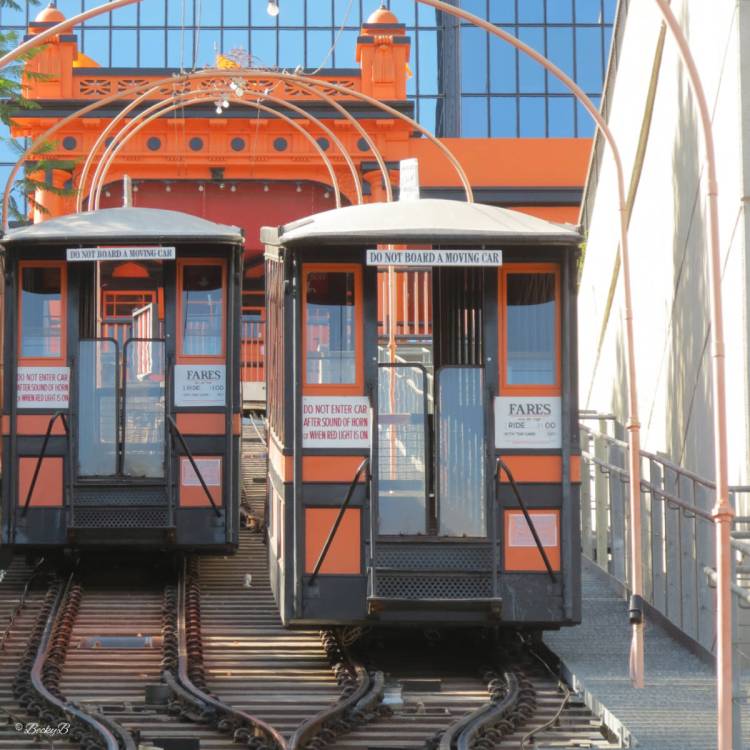
This is the second site that Angels Flight has operated on. The first site closed in the 1960s after nearly 70 years of service and then the second site re-opened here in 1996. Apparently it is not just a tourist attraction, commuters use it to travel up to the California Plaza. I decided it was quicker to walk up the steps alongside it than wait for the next car. It only travels 298 ft with a gradient of around 33%. However it was fun to see.
What is also fun is all your fabulous Geometric Squares. Only a week left of GeometricJanuary, so if you haven’t yet joined us you might want to use this weekend to square.
 The life of B
Here’s mine for today. https://heavenssunshine.com/geometrical-shapes-in-nature/
LikeLiked by 1 person
great 🙂
LikeLike
yeah ok….she says with a lost look on her face. I don’t get the chairs in that it is a tram but maybe my brain just isn’t computing what it is seeing!
LikeLiked by 1 person
hee hee think we all have a puzzled look!
LikeLike
I would enjoy riding the Angels’ Flight, I love anything like this! I was wondering how we’d missed it when in LA but then I read what you said about it closing in the 1960s and reopening in 1996 – we were there in 1991!
I’m joining in again today: https://www.toonsarah-travels.blog/gallery-geometry-in-nature-squared/
LikeLiked by 1 person
5 years too early – although have to say they do seem to keep it under wraps even now
LikeLiked by 1 person
Thank you for showing us this interesting site. Strange geometry but beautiful!
This is mine today from Lanzarote :
LikeLiked by 1 person
I agree – strange and beautiful
LikeLiked by 1 person
Heavens, but that definition of funicular geometry makes my brain go squirly. Yet I love the notion of funicular transport systems. We have one in Shropshire – at Bridgnorth, which you probably know.
More sculpture from me: https://tishfarrell.com/2025/01/24/evolutionary-geometry/
LikeLiked by 1 person
you have to wonder sometimes at those who write these explanations!
I know of that one but do you know I am not sure I have been on that one either.
LikeLike
I’ve read that quite a lot of science gobbledegook has been unleashed by Chinese AI systems spewing out apparently learned papers. It’s an explanation that makes me feel less brain-squirly 🙂
LikeLike
ahhh that would explain much
LikeLiked by 1 person
That is a beautiful picture: i love the color combination.
My square is here
LikeLiked by 1 person
thank you. It was the colours that caught my eye 🙂
LikeLike
The difference is that the geometry is not fun, but the railway is. Love those cars and the color scheme. Here’s mine today: https://grahamsisland.com/2025/01/24/peeking-nene/
LikeLiked by 1 person
hee hee, that’s an excellent point
LikeLiked by 1 person
Aah I do love a funny-peculiar!! I travelled on a very old fashioned one in Umbria (in Spello or Spoleto) – perhaps I’ll show it. Anyway, here’s today’s post from me: https://suejudd.com/2025/01/24/geometric-rooflines-7/
LikeLike
oooh that’s such a great word combination. I’ll probably get it stuck in my head as the pronunciation now!!
LikeLiked by 1 person
It was my father’s words, actually! He was a great one for puns and plays on words…
LikeLiked by 1 person
clever man
LikeLiked by 1 person
yes, an element of intelligent humour, eh?
LikeLiked by 1 person
I don’t really follow it either. They always worry me a little. Love the blue and orange though!
LikeLiked by 1 person
oh they are such fun to ride on – statistically probably safer than planes
LikeLiked by 1 person
I am staying indoors today (in sympathy with our bad weather)… but I hope you like these Geometric shapes 🙂
LikeLiked by 1 person
wise to stay indoors, and I love your shapes
LikeLike
good one, especially the second one
LikeLiked by 1 person
thank you 🙂
LikeLiked by 1 person
What a beautiful funicular, Becky. The cars have a classic shape with striking geometry and I love the colour. Not a train I’d heard mentioned before.
And as for the funicular geometry, that is not a good description is it! Also, I’m not sure the funicular curves are used in funicular transport. I think it is two different things both using the word that derives from the latin funis meaning rope.
In the transport the rope/cable is key to its operation. Whereas for the geometry used in building bridges and the like it is ropes that provide the tension to form and hold the curve. Hence the use of the same word. But don’t take my theory as fact!
LikeLiked by 1 person
yeah I think you are right – the more reading I did the more it sounded like your theory.
and glad you like it as much as I did. The colour just popped out at me. I knew nothing about it until I spotted it from my bedroom window
LikeLike