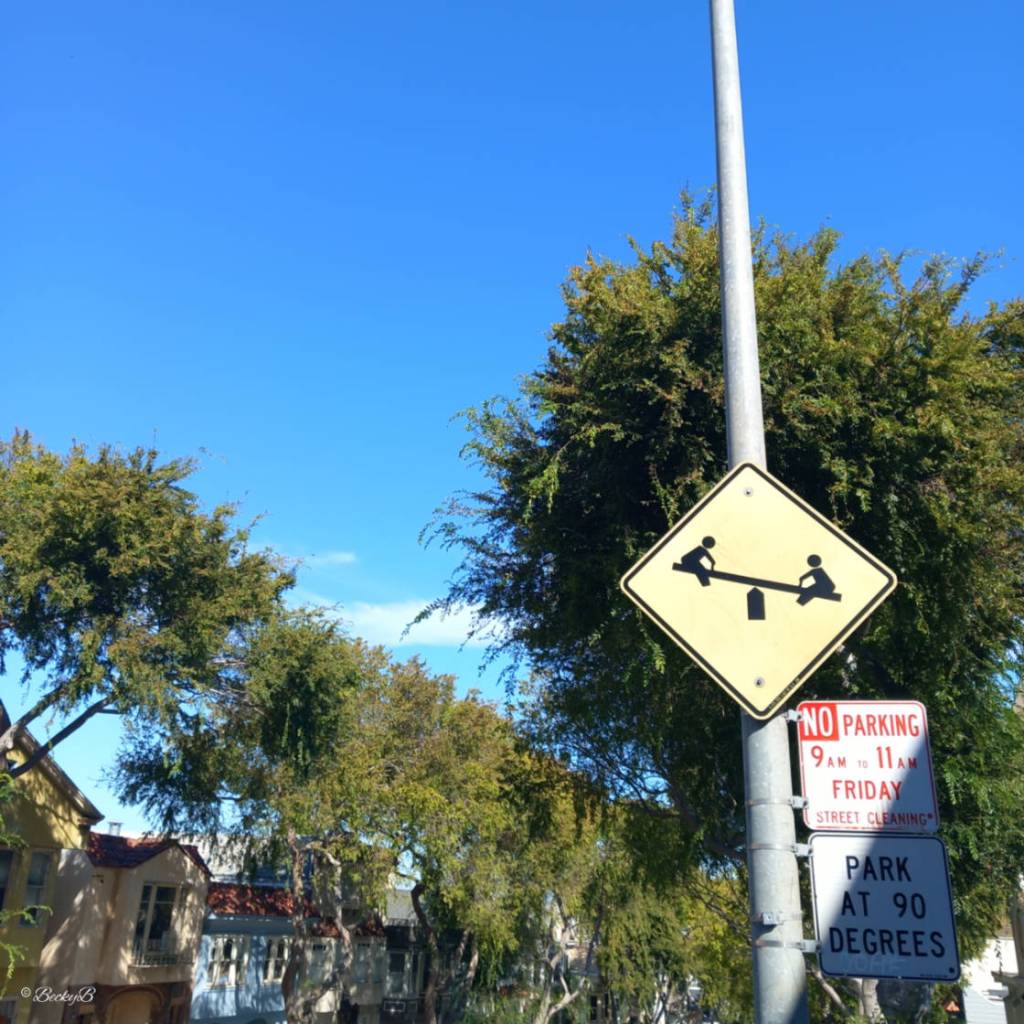
Initially I was confused by the sign. What could it mean? For a brief moment given its proximity to the parking signs on a very very steep road I was thinking it was some kind of balance warning. I know daft but the road is steep and you do have to park at 90 degrees on one side!
I entered ‘see-saw’ sign into my search engine when I got back to my San Francisco apartment, and waited in anticipation. It got me no where. So I did a reverse image search and discovered it meant a children’s play park was nearby.
However I remained confused as to why my see-saw search hadn’t brought anything up. After a bit more research I discovered the alternative American name of teeter-totter, such a great name. On chatting to American friends and family over the following days I learnt teeter-totter is not used everywhere in the USA. Some areas call it a see-saw like we do in England, others call it a tilt, and apparently even ridey-horse. Whilst the name is confusing we do at least use it the same way; we sit on it. Unlike in Korea where they stand on them and jump to propel themselves in the air, before landing again on the board. They call it ‘neolttwigi‘, and I couldn’t even imagine attempting that!
 The life of B
This is an interesting way to say there is a playground nearby. And I’m not even going to attempt to guess the next squares theme. 🤣
LikeLiked by 1 person
wise woman – all will be revealed very soon anyway!
LikeLiked by 1 person
Never at 60 degrees, too cold
LikeLiked by 1 person
hee hee!
LikeLiked by 1 person
I’m a big fan of signs that are confusing or downright misleading. I’m also no wiser as to the theme for January!
LikeLiked by 1 person
and there are always seem to be multiple confusing signs together
LikeLike
Signs of the world we live in. 🙂
LikeLiked by 1 person
so true
LikeLiked by 1 person
Ruddy teeter-totters 🤣 they just don’t understand English do they 🤣
LikeLiked by 1 person
hee hee!!
LikeLiked by 1 person
🤣🤣🤣
LikeLiked by 1 person
Signs, signs, everywhere there’s signs… that’s my guess! Which could be a broad interpretation or I could be barking up the wrong tree. As there were lots of trees in the post. Bernie
LikeLiked by 1 person
ooh I like the idea of signs – it isn’t January but maybe another month
LikeLiked by 1 person
Yes, indeed, it’s a teeter-totter! Though I also heard see-saw growing up. 🙂
LikeLiked by 1 person
ooh interesting how you heard both
LikeLiked by 1 person
Oh the memories playing on the teeter-totter brought up, Becky. Signs like this are confusing as I’ve also experienced. In southern California it was the teeter-totter. Looking forward to Janauary squares… I’m guessing signs, balance or play! 😁
LikeLiked by 1 person
oooh I like your guesses – I could certainly see one of them coming up in another month, but it isn’t January
LikeLiked by 1 person
I’m always fascinated by the differences between US and UK English, but I hadn’t heard this one. I used to love see-sawing as a child 🙂 But as for that Korean version, it sounds both scary and dangerous!
LikeLiked by 1 person
apparently it is the women in Korea who do it!
LikeLiked by 1 person
I love this as it conveys those visual and linguistic differences even when same or dare I say similar language. I find all these icons confusing and prefer a word except as with see saw might not work! just to add to confusion for some reason my oldest grand child called a great stuffed horse she was given ,when about 1, See Saw and all horses became see saws for a while! You have certainly opened up some memories with this photo.
LikeLiked by 1 person
It is fascinating isn’t it how much is so different even though the words are exactly the same – like you I find icons confusing!
does she remember calling the horses see-saws?
LikeLiked by 1 person
Oh yes, as her big cuddly horse has the name! And rabbits were Ra ra !
LikeLiked by 1 person
Love it 😀
LikeLiked by 1 person
Well this has been fascinating. And brought back a memory of a very small Alex being hit on the head by a see saw, a dash to A&E where we waited 5 hours and had to return home without seeing a doctor before the buses stopped running. (I had no money for a taxi).
LikeLike
ouch! and oh my goodness
LikeLike
A good expose and conversation starter.
LikeLiked by 1 person
Exactly!
LikeLike
What a fascinating exposition! But I haven’t guessed what we’ll all be up to in January. Obviously.
LikeLiked by 1 person
hee hee . . . . . . . well you only have to wait until next week 😉
LikeLiked by 2 people
👍
LikeLiked by 1 person
But did you go to the park for a swing?
LikeLiked by 2 people
I couldn’t even find the play park!!
LikeLiked by 2 people
Useless sign then as well as confusing
LikeLike
I know!
LikeLiked by 1 person
So you got me wondering why it was called a see-saw! Seems to make no sense, but according to Wiki:
Seesaw, or its variant see-saw, is a direct Anglicisation of the French ci-ça, meaning literally, this-that, seemingly attributable to the back-and-forth motion for which a seesaw is known. The term may also be attributable to the repetitive motion of a saw.
I had guessed the latter, but the former makes sense too. So now I’m satisfied.
LikeLiked by 2 people
I did wonder about sharing what they think the origins are – did you see another one that suggests it comes from I see …..I saw . . . .?!
LikeLike
I didn’t! I stopped at top-level or I could have gone down one of those wormholes that last all morning.
LikeLiked by 1 person
That happens to me!!
LikeLiked by 2 people
you are not alone!
LikeLike
hee hee, Robert used to do that all the time except he could disappear down one all day or even longer sometimes!
LikeLiked by 1 person
There are times when I’m very glad not to have been born in Korea. Think of the bruises!
LikeLiked by 2 people
I was thinking more likely broken bones if I tried to jump up from a moving see-saw and then attempted to land back on it!!
LikeLiked by 1 person
Teeter-totter is great though, isn’t it?
LikeLiked by 2 people
it is 😀
LikeLiked by 1 person
It’s a great word, but brings to my mind a young child wearing its mother’s high heels 👠👠
LikeLiked by 1 person
Exactly! Didn’t we all do that? X
LikeLiked by 1 person
Not me. My mother would have killed me!
LikeLiked by 2 people
hee hee, oh yes that makes much more sense
LikeLike